The Geneva Agape Foundation (GAF) strengthened its long-standing engagement with China through an institutional and academic mission in September 2026, bringing together universities, researchers and civil-society organisations around some of the major questions shaping international cooperation today.
Prof. Dr Dr h.c. Christoph Stückelberger, President of GAF, and Prof. Dr Nikolaos F. Dimitriadis, GAF Strategic Consultant, participated in meetings, lectures and academic exchanges in Beijing, Shandong and Nanjing. The mission built on relationships developed by GAF over many years while opening new areas of cooperation in AI governance ethics, human rights, intercultural dialogue, cultural heritage, education, philanthropy and civil society.
A recurring theme throughout the mission was that global cooperation requires more than identifying universal principles. It also requires the capacity to understand how values are interpreted within different cultural and intellectual traditions.
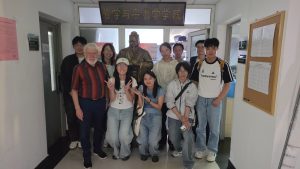
Academic Cooperation and Cultural Heritage at Minzu University
At Minzu University of China in Beijing, the mission continued GAF’s academic engagement with doctoral researchers and scholars.
Prof. Stückelberger worked with PhD candidates on doctoral research and thesis development, while Prof. Dimitriadis contributed to exchanges on Confucian and early Chinese traditions in dialogue with Ancient Greek religion and values. He also delivered a lecture on Mount Athos as living spiritual and cultural heritage. The discussions opened possibilities for further comparative research, publications, doctoral engagement and cooperation around Chinese and Greek religious and cultural heritage.
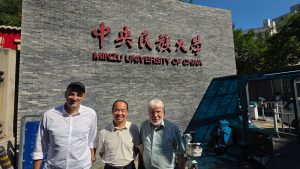
AI Governance Ethics at Shandong University
At the Law School of Shandong University, discussions focused on global ethics, law, human rights and the rapidly developing field of artificial intelligence governance.
A central point of reference was Prof. Stückelberger’s work AI Governance Ethics: Global and Contextual Values and Instruments, including its Chinese edition, Artificial Intelligence with Shared Values and Rules. The discussions explored how globally shared ethical principles can coexist with different cultural contexts. Prof. Dimitriadis contributed an intercultural ethics perspective, emphasizing that international AI governance cannot be developed through technological or regulatory considerations alone. Cultural traditions and different understandings of values must also form part of the conversation.
From Global AI Ethics to Intercultural AI Governance
This question was developed further at Tsinghua University’s Institute for AI International Governance in Beijing, where the GAF representatives participated in an expert workshop on AI governance ethics and international regulation. Prof. Stückelberger contributed from his extensive research on AI governance, while Prof. Dimitriadis presented on “AI Governance Ethics in an Intercultural Perspective.” The exchange highlighted an important direction for future GAF work: moving beyond generic formulations of “global AI ethics” towards a genuinely intercultural approach to AI governance ethics.
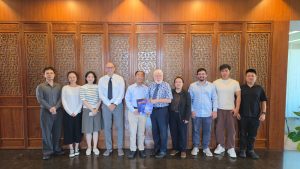
Civil Society, Philanthropy and International Cooperation
The mission also extended beyond the university sector. In Nanjing, the GAF delegation visited the Amity Foundation, engaging with its work in social development, philanthropy, education, humanitarian action and international cooperation. The programme included a visit to Amity Printing and discussions on the contribution of civil society to social responsibility and practical international cooperation. In Beijing, meetings with the China NGO Network for International Exchanges (CNIE) and the Peaceland Foundation addressed people-to-people exchange, sustainable development, humanitarian cooperation, disaster response and the role of civil society. These encounters reinforced the importance of connecting academic and ethical reflection with institutions capable of translating dialogue into practical cooperation.
Building Bridges Across Cultures
The September mission renewed existing university partnerships, broadened GAF’s civil-society network and identified several concrete areas for future cooperation. Priority areas include joint research and publications, continued engagement with doctoral researchers, further work on cultural heritage, collaboration on AI governance and human rights, and the development of China-Europe-Africa seminars and projects. In particular, Intercultural AI Governance Ethics emerged as a promising field in which GAF can bring together its experience in global ethics, intercultural dialogue, academic research and international cooperation. The mission reaffirmed a principle at the heart of GAF’s international engagement: responsible global cooperation begins with the capacity to listen across cultures, identify shared responsibilities and transform dialogue into practical cooperation.